Chapter 11: The Third Enemy — When You Become Your Own Worst Enemy
In which we discover that sometimes the greatest threat to your teeth isn't bacteria or acid—it's you, attacking yourself in your sleep
I've spent the last three chapters warning you about acid and bacteria—the chemical and microbial forces that dissolve enamel from the outside. But there's a third enemy I've been watching for millennia, one that doesn't get nearly enough attention.
This enemy doesn't care about pH. It's indifferent to your microbiome. It can destroy teeth that have never had a cavity, crack crowns that cost thousands, and wear down enamel faster than any acid attack.
This enemy is you.
Or more precisely, it's what you do in your sleep—the unconscious clenching and grinding that dentists call bruxism. And I've watched it destroy more healthy teeth than I care to count.
The Mechanics of Self-Destruction
Your jaw muscles are among the strongest in your body, relative to their size. The masseter muscle can generate forces of 150-200 pounds per square inch during normal chewing.1 That's impressive, and it's necessary—you need that force to break down food.
But during bruxism episodes, those forces can be significantly higher. Without the feedback of actual food between your teeth, without the conscious awareness that modulates normal chewing, the muscles can clamp down with forces that would never occur during waking function.
And they do this for hours.
What Bruxism Does to Teeth
Attrition: The grinding surfaces of teeth wear flat. Molars lose their cusps. Incisors develop sharp, chipped edges. The enamel thins progressively, eventually exposing the softer dentin beneath. I've seen teeth worn down to nubs in people who were otherwise meticulous about their oral health.
Abfraction lesions: These are the mysterious notches that appear at the gumline—not from brushing too hard (though that's often blamed), but from the flexing of teeth under excessive lateral forces.2 When you grind, teeth bend microscopically. At the cervical area (the neck of the tooth, where crown meets root), this flexing causes enamel crystals to flake away. The result is a wedge-shaped lesion that looks like someone took a tiny axe to your tooth.
Cracked teeth: Perhaps the most heartbreaking consequence. A perfectly healthy tooth, no decay, no previous work—and one night it fractures under grinding forces. Sometimes the crack is superficial (craze lines). Sometimes it extends into the dentin. Sometimes it splits the tooth vertically, rendering it unsaveable.
Failed restorations: Crowns pop off. Fillings crack. Veneers chip. The dental work you've invested in—financially and physically—can't withstand forces it was never designed for.
TMJ disorders: The temporomandibular joint, where your jaw meets your skull, bears the brunt of bruxism forces. Over time, this can lead to joint pain, clicking, limited opening, and chronic discomfort that extends into headaches and neck tension.
Sleep Bruxism vs. Awake Clenching
There are actually two distinct phenomena here, and understanding the difference matters for management.
Sleep Bruxism
This is what you're doing unconsciously during sleep—rhythmic grinding movements, often occurring during transitions between sleep stages. Sleep bruxism:
- Occurs without awareness
- Can't be consciously controlled
- Is associated with micro-arousals in sleep architecture
- May have genetic components
- Is diagnosed definitively only through sleep studies (polysomnography), though clinical signs are often sufficient
You may wake with a sore jaw, morning headaches (particularly in the temples), or teeth that feel "tired." Your partner may hear the grinding—a distinctive sound that, once recognized, is unmistakable.
Awake Clenching
This is daytime jaw tension—holding your teeth clamped together during concentration, stress, or physical exertion. Unlike sleep bruxism:
- Can potentially be consciously interrupted once you're aware of it
- Is strongly associated with stress and anxiety
- May involve sustained clenching more than grinding
- Often goes unnoticed because it's become habitual
Many people do both. The combination is particularly destructive.
The Stress Connection
Here's where my perspective as an ancient observer becomes relevant. I've watched bruxism rates climb over the centuries, and the pattern is clear: bruxism correlates with stress.
In simpler times—and yes, those times had their own stresses, but of different kinds—I saw less grinding. In modern humans, with their chronic low-grade anxiety, their screens that stimulate before sleep, their minds that never fully stop, bruxism has become epidemic.
The mechanism isn't fully understood, but the association is robust. Stress increases muscle tension. Anxiety activates the sympathetic nervous system even during sleep. The jaw, which many people unconsciously clench when stressed, becomes a battleground where psychological tension manifests as physical destruction.
I'm not suggesting that all bruxism is psychological—there are neurological and structural factors too. But in my observation, the modern epidemic of grinding correlates with the modern epidemic of never quite being at rest.
The Ecological Irony
Here's what frustrates me most about bruxism: it can undo everything else you're doing right.
You can have perfect pH management. You can nurture your oral microbiome with ecological rinses. You can avoid sugar, use n-HAp toothpaste, do everything this book recommends—and still lose teeth to grinding.
It's like tending a garden meticulously, nurturing every plant, managing the soil pH perfectly—and then walking through it every night in hobnailed boots, crushing what you've cultivated.
The chemical and microbial aspects of oral health are necessary but not sufficient. Mechanical forces matter too. And bruxism is mechanical destruction operating on a different axis from everything else we've discussed.
Signs You Might Be Grinding
Since sleep bruxism happens unconsciously, how do you know if you're doing it? Here are the clinical signs:
Self-observed:
- Waking with jaw pain or fatigue
- Morning headaches, especially in the temples
- Teeth that feel sensitive without obvious cause
- Catching yourself clenching during the day
- Noticing teeth look flatter or shorter than they used to
Partner-observed:
- Grinding sounds during sleep (ask them!)
Dentist-observed:
- Wear facets (shiny, flat spots on chewing surfaces)
- Abfraction lesions at the gumline
- Craze lines (fine cracks in enamel)
- Fractured cusps or restorations
- Enlarged masseter muscles (you can sometimes see this as squaring of the jaw)
- Scalloped tongue edges (from pressing tongue against teeth)
- Cheek ridging (linea alba—white line inside cheeks from tissue compression)
If you recognize several of these signs, you're likely grinding.
The Professional Solution: Night Guards
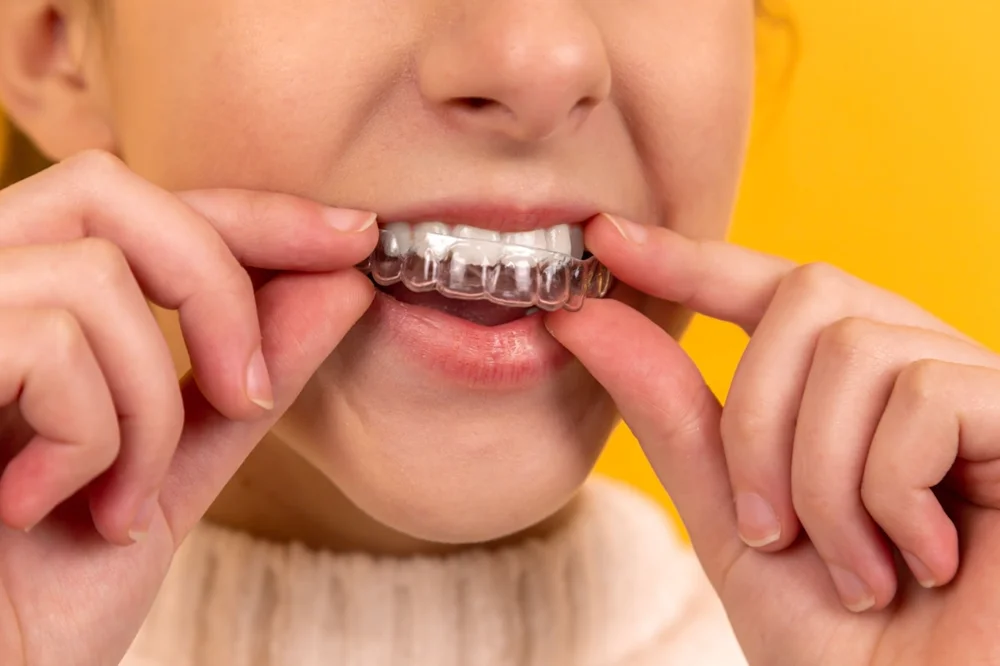
Let me be direct: if you have significant bruxism, you probably need a night guard (also called an occlusal splint or bite guard).
This is a custom-fitted appliance, usually made of hard acrylic, that covers your upper or lower teeth. It doesn't stop the grinding—that's a neurological pattern that continues regardless. What it does is:
- Distribute forces across a larger surface area
- Protect enamel by having the grinding occur against acrylic instead of opposing teeth
- Provide a sacrificial surface that wears instead of your teeth
- Reduce muscle strain by putting the jaw in a slightly more relaxed position
A properly made night guard from a dentist costs several hundred dollars but can save thousands in dental work. It needs to be custom-fitted; over-the-counter "boil and bite" guards are better than nothing but don't provide the same level of protection or comfort.
Some people resist wearing a night guard. It feels strange. It's one more thing to deal with. I understand. But I've watched too many teeth crack, too many crowns fail, too much enamel disappear. If your dentist recommends one, please take it seriously.
Natural and Complementary Approaches
A night guard protects teeth, but it doesn't address the underlying grinding behavior. For that, we need to think about what drives bruxism—and here's where some gentler approaches come in.
Stress Reduction
Since stress is the major modifiable factor in bruxism, addressing it matters:
Before bed:
- Reduce screen exposure in the hour before sleep
- Practice relaxation techniques (progressive muscle relaxation is particularly relevant for jaw tension)
- Avoid stimulating content—news, arguments, intense movies
- Consider a brief meditation or breathing practice
General stress management:
- Regular exercise (but not too close to bedtime)
- Adequate sleep duration
- Addressing underlying anxiety if present
- Counseling or therapy for chronic stress
I recognize these recommendations may sound generic. But they're generic because they're fundamental. The nervous system that drives grinding is the same nervous system you're calming with these practices.
Magnesium
Magnesium is involved in muscle relaxation—it's the counter-ion to calcium in the contraction-relaxation cycle. Many people are mildly magnesium-deficient, and supplementation may help with muscle tension including jaw clenching.3
Forms and dosing:
- Magnesium glycinate or citrate are well-absorbed
- 200-400mg before bed is a common recommendation
- Start lower to assess tolerance (magnesium can cause loose stools)
- Topical magnesium (oil or lotion) applied to jaw muscles is also used, though evidence is limited
This isn't a cure, but it's a safe, inexpensive intervention that may help at the margins.
Herbal Support
Several herbs traditionally used for nervous tension may help with bruxism:
Valerian (Valeriana officinalis): A classic nervine sedative that may help with sleep quality and muscle relaxation. Traditional use for teeth grinding is noted in herbal literature.4 Take as tea or tincture before bed.
Passionflower (Passiflora incarnata): Another calming herb that may reduce anxiety-related muscle tension. Often combined with valerian.
Kava (Piper methysticum): Muscle-relaxant and anxiolytic properties. Concerns about liver toxicity have limited its use, but traditionally prepared kava appears safer than concentrated extracts.
Chamomile (Matricaria chamomilla): Gentle relaxant, safe for regular use. May help with overall tension reduction.
I must be honest: the evidence for herbal treatment of bruxism specifically is limited. These herbs may help with the stress and tension that contribute to grinding, but they won't stop a deeply ingrained neurological pattern. Think of them as supportive, not curative.
Jaw Exercises and Massage
The masseter and temporalis muscles that power grinding can become hypertrophied and chronically tense. Direct intervention can help:
Massage: Use your fingertips to massage the masseter muscles (on the outside of your jaw, between cheekbone and jaw angle) and temporalis (at the temples). Gentle, sustained pressure. Do this before bed and whenever you notice tension.
Stretching: Gently open your mouth as wide as comfortable, hold for 10 seconds, release. Repeat several times. This stretches the muscles that clamp the jaw shut.
Awareness: During the day, practice the "lips together, teeth apart" position. Your resting jaw position should have your lips gently closed but your teeth not touching. Many people unconsciously hold their teeth together; consciously releasing this habit can help.
Biofeedback
Devices exist that detect jaw clenching (through EMG sensors or pressure) and provide feedback—a vibration, a sound—to interrupt the pattern. Some people find these helpful for building awareness of daytime clenching. For sleep bruxism, the evidence is more limited, but it's an area of active development.
When Grinding Indicates Something Else
I should mention that bruxism can sometimes be secondary to other conditions:
Sleep apnea: There's an association between obstructive sleep apnea and bruxism. The grinding may be a response to airway obstruction. If you snore heavily, wake gasping, or have excessive daytime sleepiness, a sleep study is warranted.
Medications: Certain medications, particularly SSRIs and other antidepressants, can cause or worsen bruxism. If grinding started or worsened after starting a medication, discuss with your prescriber.
Neurological conditions: In some cases, bruxism relates to underlying neurological issues. If you have other neurological symptoms, evaluation is warranted.
Gastroesophageal reflux: Some research suggests a connection between GERD and bruxism, possibly as an unconscious protective mechanism (saliva production from grinding neutralizes acid).
Addressing these underlying conditions may help with bruxism more than any direct treatment.
The Tooth Fairy's Lament
I've saved this topic for last among the enemies because it's the one that makes me saddest.
Acid and bacteria—those I can teach you to manage. Give you rinses, explain pH, help you understand your microbiome. The enemy becomes manageable once you understand it.
But bruxism? You're literally attacking yourself. Often during sleep, when you have no awareness, no control. You wake up having spent hours destroying what you've worked to protect.
It's like watching someone tend a beautiful garden all day, then sleepwalk through it at night, trampling the flowers.
And yet—here's the hope—even bruxism can be managed. Not cured, necessarily, but managed. A night guard protects your teeth while you figure out deeper solutions. Stress reduction helps over time. Awareness of daytime clenching gives you something you can actually control.
The teeth I've collected from grinders—cracked molars, worn-down incisors, fractured crowns—didn't have to be lost. They could have been protected. The damage could have been prevented, or at least slowed to a pace that allowed for a full lifetime of function.
If you're grinding, please address it. Talk to your dentist. Consider a night guard. Look at your stress. Explore the herbs and minerals that might help. Because this enemy is you, and the only one who can make peace is also you.
Your teeth are caught in the middle of a war you're waging against yourself. It's time to declare a truce.
We've now covered the three great enemies of your teeth: acid, bacteria, and mechanical force. In the next section, we'll move from understanding threats to crafting solutions—the chemistry of care that can protect what you have.
-
Ferrario, V. F., et al. (2004). Maximum bite forces in healthy young adults as predicted by surface electromyography. Journal of Dental Research, 83(4), 286-290. ↩
-
Grippo, J. O., et al. (2004). Abfraction: a new classification of hard tissue lesions of teeth. Journal of Esthetic and Restorative Dentistry, 16(5), 306-313. ↩
-
Held, K., et al. (2002). Oral Mg supplementation reverses age-related neuroendocrine and sleep EEG changes in humans. Pharmacopsychiatry, 35(4), 135-143. ↩
-
Hoffmann, D. (2003). Medical Herbalism: The Science and Practice of Herbal Medicine. Healing Arts Press. Notes valerian's traditional use for nervous tension affecting the musculature. ↩