Chapter 1: The Crystal Under Siege
In which we meet hydroxyapatite, learn why your teeth are constantly dissolving, and discover that rebuilding them is not only possible but happening right now
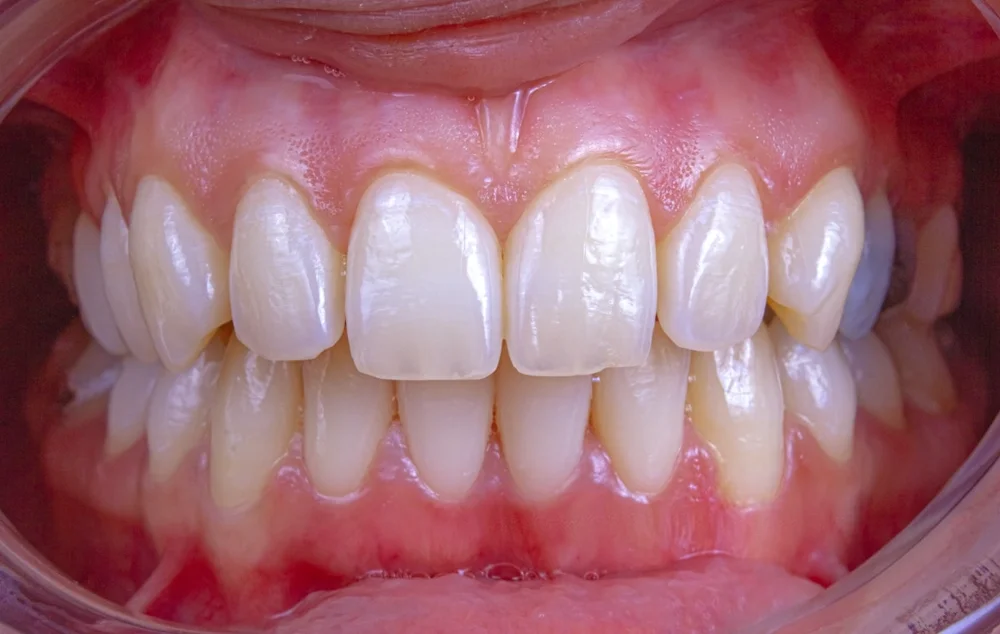
Let me introduce you to the hardest substance your body will ever produce.
It's not bone, though people often make that mistake. Bone is impressive in its own way—strong, flexible, capable of healing and remodeling itself throughout your life. But bone is only about 65% mineral.1 The rest is proteins and living cells, which is why bone can repair a fracture in ways that a tooth never could.
No, the hardest thing you'll ever make is enamel: the thin, lustrous outer layer of your teeth. And enamel is 96% mineral.2 It's essentially a crystal that your body grew during childhood and then handed to you with the implicit instruction: Don't mess this up. This is all you get.
That crystal has a name, and it's worth knowing: hydroxyapatite.3
The Architecture of Enamel
Hydroxyapatite is a calcium phosphate mineral with a specific crystalline structure. If you want to get technical about it—and I'm going to assume you do, because you're still reading—the chemical formula is:
Ca₁₀(PO₄)₆(OH)₂
What this tells us is that each unit of the crystal contains:
- 10 calcium ions (Ca²⁺)
- 6 phosphate groups (PO₄³⁻)
- 2 hydroxide ions (OH⁻)
These components are arranged in a hexagonal lattice—a repeating geometric pattern that gives enamel its remarkable combination of hardness and resistance to chemical attack. If you could see enamel at the atomic level, you'd find these hexagonal rods, called enamel prisms, running from the deeper layers of the tooth out to the surface.4 Millions of them, packed together, oriented to resist the forces of chewing.
This is no accident. Evolution spent hundreds of millions of years optimizing this structure. The earliest fish were developing hard mineralized tissues for their teeth 400 million years ago.5 Every refinement, every improvement in the crystal structure, every subtle optimization in the organic matrix that templates the mineral deposition—all of it was selected for because it helped organisms process food more effectively and survive longer.
The result is engineering that human materials science still struggles to replicate. Enamel is harder than steel (about 5 on the Mohs hardness scale),6 yet it can withstand repeated cycles of stress that would shatter a purely crystalline material. It's less than 3 millimeters thick at its deepest point, yet it protects the softer, living tissues beneath it decade after decade.
And here's what you need to understand: despite all this toughness, enamel is under constant chemical assault. Every day. Every hour. Every time you eat or drink anything.
The Equilibrium
Here's where we get to the part that most people never learn, the thing that would have saved countless teeth if only it were common knowledge:
Enamel dissolution is not a disease. It's chemistry.
Your hydroxyapatite crystals don't exist in isolation. They're bathed in fluid—primarily saliva—that contains dissolved calcium, phosphate, and hydroxide ions. And here's the crucial thing: those ions are in dynamic equilibrium with the solid crystal.
This equilibrium can be written as:
Ca₁₀(PO₄)₆(OH)₂ ⇌ 10Ca²⁺ + 6PO₄³⁻ + 2OH⁻
That double arrow is everything. It means the reaction goes both directions. The solid crystal can dissolve into its component ions, and those ions can re-precipitate back into solid crystal. Which direction the reaction goes at any given moment depends on the concentrations of ions in the surrounding fluid.
Chemists describe this with something called the ion activity product (IAP)—essentially, a measure of how many dissolved ions are in the fluid. And they compare it to the solubility product constant (Ksp)—a fixed value that describes how much dissolution the system "wants" at equilibrium.
Three scenarios are possible:
If IAP > Ksp: The fluid is supersaturated with ions. There are more dissolved minerals than the equilibrium can support. The system responds by depositing minerals back onto solid surfaces. Net result: Remineralization. Your enamel gains mineral.
If IAP = Ksp: The system is at equilibrium. No net change. Dissolution and precipitation are happening at equal rates, so the enamel structure stays constant.
If IAP < Ksp: The fluid is undersaturated. There aren't enough dissolved minerals to satisfy the equilibrium. The system responds by dissolving more solid crystal to release ions. Net result: Demineralization. Your enamel loses mineral.
This is the fundamental chemistry governing whether your teeth survive or dissolve. It's happening right now, in your mouth, and it will continue every moment of your life.
The pH Connection
So what determines whether the fluid around your teeth is supersaturated or undersaturated? Several factors, but the most important is pH—the concentration of hydrogen ions in the solution.
Here's why pH matters: hydrogen ions (H⁺) are greedy. They react with and consume the phosphate and hydroxide ions that are floating in solution:
PO₄³⁻ + H⁺ → HPO₄²⁻
OH⁻ + H⁺ → H₂O
When acid enters your mouth—from food, from drinks, from bacterial metabolism—the hydrogen ions start grabbing phosphate and hydroxide out of solution. This drops the IAP. Suddenly the fluid is undersaturated, and the equilibrium shifts toward dissolution. Your enamel literally dissolves to replace the ions that the acid consumed.
This is why acid is the enemy. Not because it attacks enamel directly (though strong acids can do that too), but because it shifts the equilibrium. It changes the chemical environment in a way that makes dissolution thermodynamically favorable.
The concept of critical pH comes from this understanding. For typical saliva composition, the critical pH is around 5.5.7 Above this pH, saliva is supersaturated with respect to hydroxyapatite, and remineralization can occur. Below this pH, saliva becomes undersaturated, and demineralization begins.
But—and this is important—the critical pH isn't a fixed universal constant. It depends on the calcium and phosphate concentrations in the fluid.8 In saliva with very high mineral content, enamel can resist dissolution at lower pH values. In saliva with low mineral content, demineralization can begin at higher pH.
This is why saliva composition matters, why some people seem more prone to cavities than others, and why anything that increases the mineral content of oral fluids can help protect teeth. We'll explore this more in the next chapter.
The Daily Cycle
If this all sounds rather alarming—your teeth constantly dissolving every time you encounter acid—let me offer some reassurance. The system has a remarkable capacity for self-repair, if you give it the opportunity.
Here's what happens when you eat something:
-
The attack phase. Food introduces acids directly (citric acid in fruit, acetic acid in vinegar, etc.) or provides sugars that bacteria ferment into acids (primarily lactic acid). Plaque pH drops, often to 5.0 or below. In this acidic environment, enamel begins to demineralize. The outermost layer—perhaps the top 1-2 micrometers—starts to dissolve.
-
The clearance phase. You finish eating. Saliva flow increases (stimulated by chewing). The saliva dilutes and buffers the acids, gradually raising the pH back toward neutral.
-
The repair phase. Once pH rises above the critical threshold, the supersaturated saliva can begin depositing minerals back into the partially dissolved enamel surface. Given enough time—typically 30-60 minutes—the softened surface layer re-hardens.
This cycle happens every time you eat. Every single time. Your teeth spend their days in a constant rhythm of partial dissolution and repair.
The key insight is this: if the repair phases outweigh the attack phases, your teeth survive. If the attack phases accumulate faster than repair can keep up, you get cavities.
This is why meal timing matters. This is why snacking frequency can be more damaging than total sugar consumption. This is why certain habits are devastating while others that might seem similar are relatively harmless.
Consider two people who consume the same total amount of sugar in a day:
Person A has a large dessert after dinner, consuming 50 grams of sugar in one sitting. Their mouth experiences one acid attack, lasting maybe 30-40 minutes, followed by several hours of recovery before bed.
Person B sips a sweetened coffee drink throughout the morning, nibbles candy in the afternoon, and has a small dessert at night. They consume the same 50 grams of sugar, but distributed across five or six separate exposures. Their mouth experiences five or six separate acid attacks, with minimal recovery time between them.
Person B will develop far more cavities than Person A, despite identical total sugar consumption. The pattern matters more than the amount.
The Softened Surface
One more thing you should understand about the demineralization process: during the attack phase, the enamel surface doesn't disappear completely. It becomes softened—a partially demineralized zone where the crystal structure is intact but weakened.
This softened enamel is vulnerable in a way that intact enamel is not. Specifically, it's vulnerable to mechanical abrasion. The weakened crystals can be physically removed by brushing, by hard foods, by anything that scrapes across the tooth surface.
This is why one of the most damaging things you can do is brush your teeth immediately after consuming something acidic. Your enamel is in its softened state. The bristles that would normally glide harmlessly across a hardened surface instead remove enamel crystals that haven't had time to re-harden.
The conventional advice—wait 30 minutes after eating before brushing—comes directly from this chemistry. You're not being asked to wait arbitrarily. You're being asked to wait until the remineralization process has had time to restore surface hardness.
If you absolutely must do something after an acidic meal or drink, rinse with plain water or a baking soda solution. This helps neutralize the acid and speeds the return to safe pH without any abrasive action.
What We've Learned
Let me summarize the essential points, because everything that follows builds on this foundation:
-
Enamel is a crystal (hydroxyapatite) that exists in dynamic equilibrium with the ions dissolved in surrounding fluid.
-
Dissolution and rebuilding are constant processes, governed by the saturation state of oral fluids.
-
pH is the master variable. Acid exposure shifts the equilibrium toward dissolution by consuming phosphate and hydroxide ions.
-
The critical pH is around 5.5 for typical saliva, below which demineralization occurs.
-
Attack and repair cycles happen throughout the day. Net tooth health depends on which phase dominates over time.
-
Timing matters more than amount. Frequent acid exposures are more damaging than occasional large ones.
-
Softened enamel is vulnerable to mechanical removal. Don't brush immediately after acid exposure.
This chemistry has been operating in your mouth every day of your life. It operated in your parents' mouths, and their parents' mouths, all the way back to the first creatures that evolved mineralized teeth. It's not mysterious. It's not random. It's predictable.
And because it's predictable, it's controllable.
Now let's talk about the fluid that makes repair possible—the remarkable, supersaturated, mineral-rich solution that evolution engineered specifically to keep your teeth alive. Let's talk about saliva.
-
Boskey, A. L. (2007). Mineralization of bones and teeth. Elements, 3(6), 385-391. Bone is approximately 65% mineral by weight, with the remainder consisting of organic matrix (primarily collagen) and water. ↩
-
Tooth enamel — Wikipedia. Enamel is 96% mineral, making it the hardest and most mineralized substance in the human body. ↩
-
Hydroxyapatite — Wikipedia. The primary mineral component of tooth enamel and bone, with the chemical formula Ca₁₀(PO₄)₆(OH)₂. ↩
-
Nanci, A. (2017). Ten Cate's Oral Histology: Development, Structure, and Function (9th ed.). Elsevier. Enamel prisms (or rods) are the basic structural units of enamel, running from the dentin-enamel junction to the tooth surface. ↩
-
Donoghue, P. C., & Rücklin, M. (2016). The ins and outs of the evolutionary origin of teeth. Evolution & Development, 18(1), 19-30. Mineralized dental tissues first appeared in fish approximately 400 million years ago. ↩
-
Mohs scale of mineral hardness — Wikipedia. Tooth enamel has a Mohs hardness of approximately 5, comparable to apatite. ↩
-
Dawes, C. (2003). What is the critical pH and why does a tooth dissolve in acid? Journal of the Canadian Dental Association, 69(11), 722-724. The critical pH for enamel dissolution is approximately 5.5 for typical saliva composition. ↩
-
Featherstone, J. D. (2008). Dental caries: a dynamic disease process. Australian Dental Journal, 53(3), 286-291. The critical pH varies based on the calcium and phosphate ion concentrations in the surrounding fluid. ↩